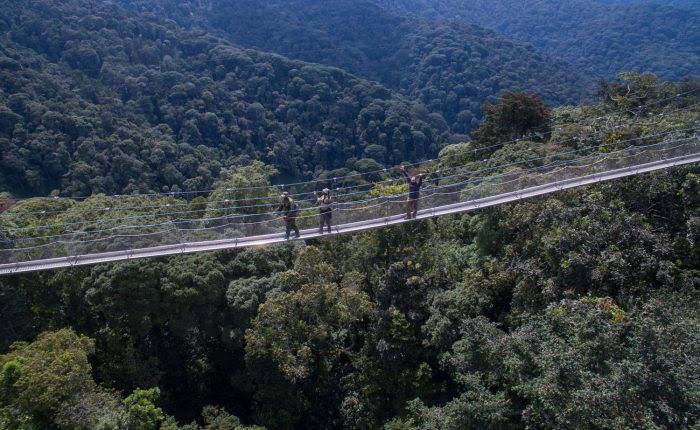
There are not many places in Africa where you can stand in the crown of a rainforest and look down on the birds. In Nyungwe you can. A narrow suspended walkway runs through the treetops, about 70 metres above the forest floor, and when the morning mist lifts and the trees steam in the first light, it is one of the most memorable half-hours in Rwanda Nyungwe Forest canopy walk.
It is also one of the most misunderstood. People imagine either a terrifying rope bridge or a gentle stroll, and it is neither. It is a well-built walkway in a spectacular setting, and it rewards anyone who plans the visit properly, which means choosing the right morning, getting the logistics right and knowing what to expect.
This guide covers everything you need to know about Nyungwe Forest canopy walk: what the walk is like, how hard it is, what it costs, when to go, how to get there from Kigali and how to combine it with chimpanzee trekking and the rest of Nyungwe.
At a glance: The Nyungwe canopy walk is a suspended walkway about 70 metres above the forest floor in Nyungwe Forest National Park, in south-western Rwanda. The park rates it as a moderate activity. It counts as a special activity at about USD 40 per person for international visitors. Mornings are best, and Nyungwe is a long drive from Kigali, so plan an overnight stay
What is the Nyungwe canopy walk?
Nyungwe Forest National Park protects one of the largest blocks of montane rainforest in the region. It rises from about 1,600 to nearly 3,000 metres above sea level, and it is home to chimpanzees, large troops of colobus monkeys, more than a dozen primate species in all and hundreds of bird species. You can read more about the forest on the Nyungwe Forest Wikipedia page.
The canopy walkway is the park’s signature activity after chimpanzee trekking. It is a suspended bridge, strung between towers and trees, that lets you walk out into the canopy itself. Instead of looking up from the forest floor at a ceiling of leaves, you stand at the level of the leaves and look down into a rolling sea of green. Birds fly past at eye level, monkeys move through the branches nearby and the forest spreads out around you in every direction.
The walkway starts from the Uwinka area of the park, where the trailheads and visitor facilities are based. It is a guided activity, and groups are kept small so that the structure and the experience are not overcrowded.
What it is really like
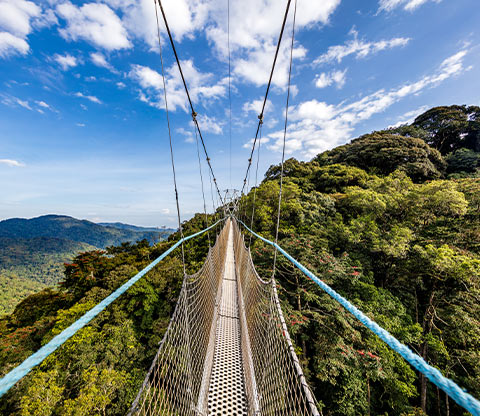
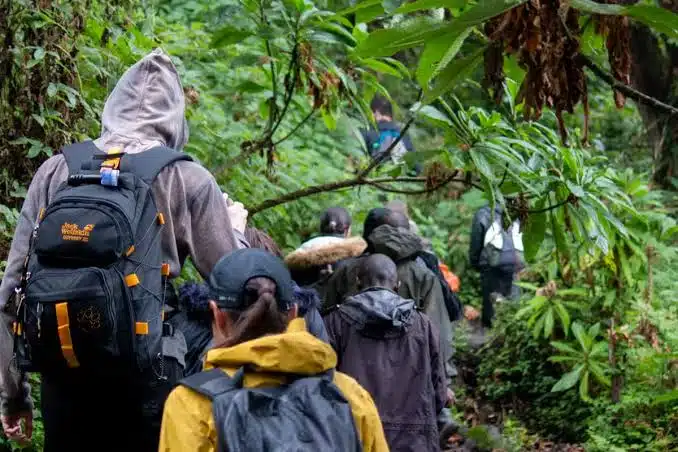
The walk begins with a short hike through the forest to reach the start of the bridge. The trail is easy to moderate, with some stairs and slopes, and it gives you a good introduction to the forest before you step out onto the walkway.
The bridge itself is narrow and made of metal mesh with strong side netting. It moves slightly under your feet, as any suspended structure does, and you can see through the mesh to the forest far below. For most people the first few steps are the most nervous, and after that the view takes over. You walk slowly, stopping often to look, and a guide explains what you are seeing.
What you see depends on the weather and the hour. On a clear morning, the views stretch across the forest and over the hills beyond. In mist, the forest floats in and out of cloud, which is dramatic in its own way. Birds are often most active early, and with luck you may see colobus monkeys or other primates in the nearby trees.
How hard is the Nyungwe canopy walk?
The park classes the activity as moderate. In practice that means you need to be comfortable walking for an hour or two on forest paths, with some steps and slopes, and comfortable with heights.
The main challenge is psychological rather than physical. If you suffer from vertigo, think carefully. Many people who are nervous about heights manage the walk by staying close to the centre, keeping their eyes on the horizon rather than straight down, and moving at their own pace. If you are unsure, tell your guide before you start, and be honest with yourself about whether you will enjoy it.
Physically, the walk is much easier than chimpanzee trekking, which the park rates as difficult. That makes it a good activity for a second morning, or for travellers who want a taste of Nyungwe without the demands of a full chimp trek. Anyone with serious mobility problems, or with a medical condition affecting balance, should check with us first.
What does the Nyungwe canopy walk cost?
The park publishes its prices, and we use those figures when we quote. Under the 2025 to 2026 pricing scheme, international visitors pay about USD 40 per person for the canopy walk, which the park counts as a special activity alongside guided birding, other primate trekking and night walks. You also pay park entry, which is USD 100 per person for one day or night, USD 150 for two nights and USD 200 for three, because the fee drops for later nights.
That means a one-night visit with the canopy walk comes to around USD 140 in park fees, and a visit with chimpanzee tracking as well, which costs USD 150, comes to about USD 290. Lodging, meals and transport are on top.
Park rates are reviewed from time to time, so we double-check the current figures before we confirm any quote for 2027. The park also publishes a cancellation scale: cancelling more than 30 days before arrival costs nothing, between 30 and 7 days costs 30 percent, and inside seven days costs half. Peak dates can fill, so booking early is worth it. The official Visit Nyungwe site is the best place to check current details.
When is the best time to walk the canopy?
Early morning is almost always best, whatever the season. The forest is quiet, the light is soft, birds are active and the walkway is less crowded. In the middle of the day the forest can be busier and the visibility can be poorer.
For the time of year, the dry months from June to September and from mid-December to February are the most comfortable. Paths are firmer, mist clears sooner and the views are generally better. They are also the park’s high season, so lodges and permits fill early.
The wetter months from March to May and from October to mid-December are quieter and cheaper, and the forest looks spectacular, though rain and cloud can sometimes obscure the view. Because Nyungwe is a rainforest, showers can arrive at any time of year, so bring a rain jacket whenever you go.
Getting to Nyungwe from Kigali
Nyungwe lies in the south-west of Rwanda, and the drive from Kigali takes roughly five to six hours, depending on traffic and stops. That is why we treat it as an overnight destination rather than a day trip. Two nights is a comfortable minimum, giving you a travel day, a full activity day and a bit of time to enjoy the forest and the tea plantations.
The journey is part of the experience. The road winds through terraced hills, villages and tea estates, with plenty of photo stops.
Combining the canopy walk with chimpanzee trekking
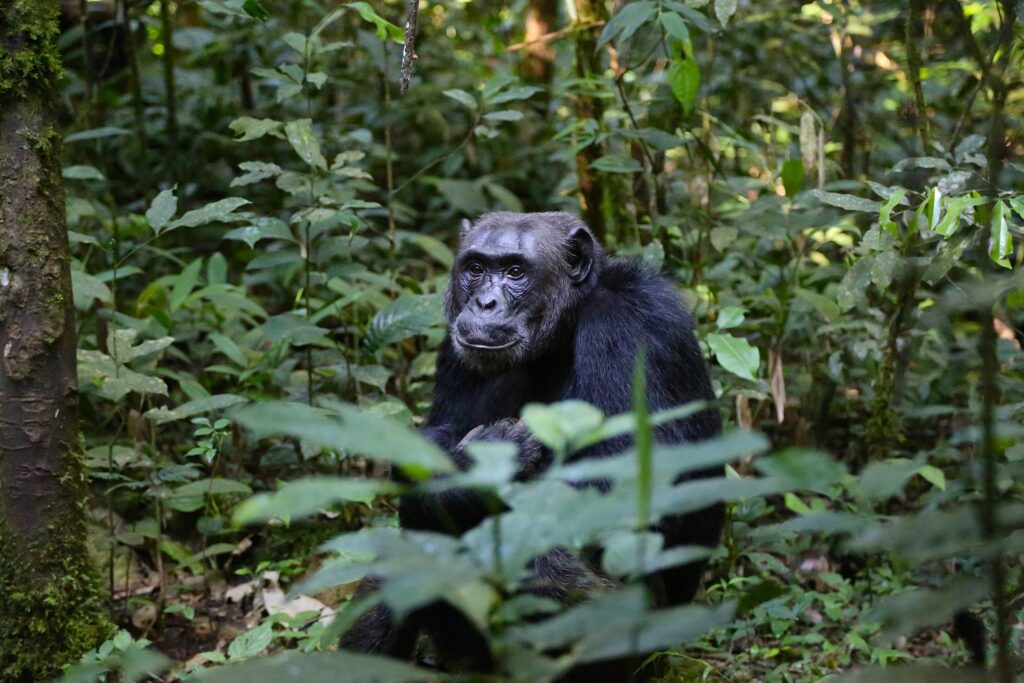
Most visitors do the canopy walk and chimpanzee tracking together, and they fit neatly on the same day or on consecutive mornings. Chimps are usually tracked first, because they are most active in the cool early hours, and the canopy walk follows or comes the next morning.
On our seven-day itinerary, day two is exactly that: chimpanzee trekking, the canopy walk and a visit to a tea plantation. The combination gives you two completely different perspectives on the forest, one at ground level with the primates and one in the treetops.
Other things to do in Nyungwe
The canopy walk is not the only reason to visit. Nyungwe has a long list of activities and wildlife.
Birdwatching
The forest is one of the best birding sites in Africa, with more than 300 species recorded, including many Albertine Rift endemics that birders travel a long way to see. A guided birding walk counts as a special activity under the park’s pricing scheme. Our upcoming guide to bird watching in Rwanda will cover this in more detail.
Colobus monkeys and other primates
Large troops of colobus monkeys are one of the park’s sights, and you often see them without any special effort. Other primates include several species of guenons, mangabeys and, of course, chimpanzees.
Tea plantations
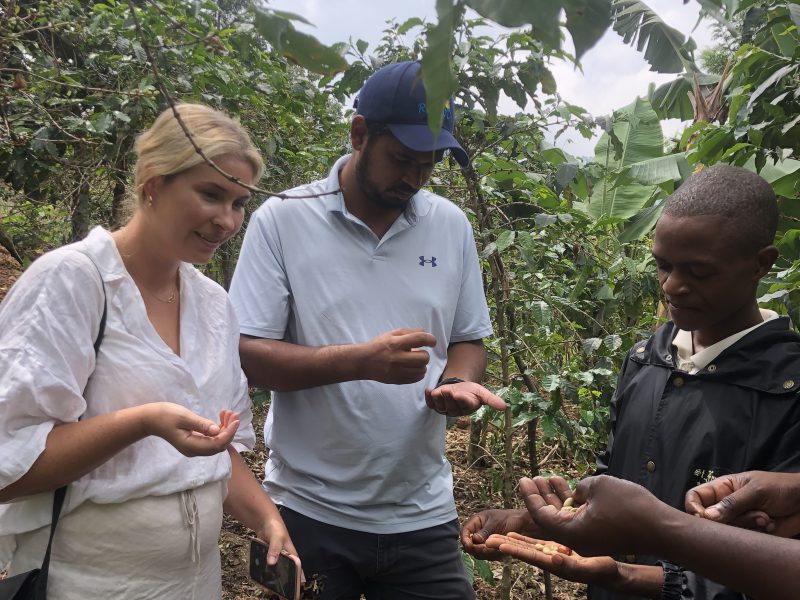
The hillsides around the park are covered in neat rows of tea. A visit to a plantation is a gentle, rewarding activity, with a chance to learn how the leaves are picked and processed, and it is a nice contrast to the effort of the forest.
Forest walks, zipline and waterfalls
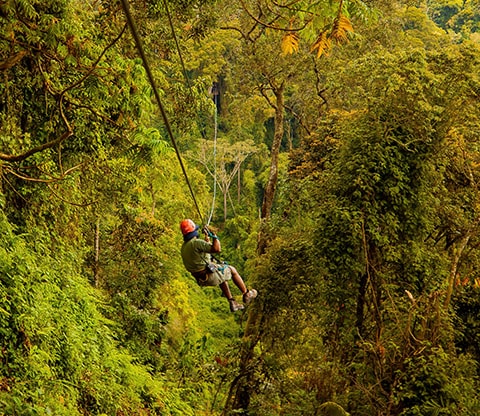
The park has zipline, a network of trails of different lengths and difficulty, some leading to waterfalls and viewpoints. They are a good option if you want more time in the forest without the demands of chimp trekking.
What to wear and bring
You do not need much, but the right items make the day more comfortable.
Wear sturdy shoes with good grip, because forest paths can be slippery. Bring a waterproof jacket, since it can rain in any month. Dress in layers: mornings are cool and the forest is damp, while the sun can be strong when it breaks through. Long trousers protect against plants and insects.
Carry a small daypack with water, a hat, sunscreen and a camera or binoculars. Leave large bags and loose items behind, because on the walkway you want both hands free. Our East Africa safari packing list cover the rest, and most of the kit does double duty in Nyungwe and Volcanoes.
A morning on the walkway, step by step
To make the experience less abstract, here is how a typical canopy morning unfolds.
You wake early at your lodge, with the forest still dark and cool outside. After a hot breakfast, you drive to the Uwinka area, where a guide meets your group, checks that everyone is comfortable and explains the rules: stay in single file, keep belongings secure, move at an easy pace and ask if you need to stop. The briefing is short and friendly.
You then walk through the forest towards the start of the bridge, passing huge trees draped in moss, ferns and orchids. Along the way your guide points out birds, plants and signs of primates, and you start to get a feel for how much life is hidden in the leaves. When you reach the first tower, you climb the steps up to the level of the canopy.
Stepping onto the walkway is the part everyone remembers. The first steps feel odd, because the bridge moves slightly and the ground is a long way down. Within a minute or two most people relax. You walk out to the middle, stop and look. Mist hangs in the valleys, birds call from the trees below you, and the forest stretches away in layers of green. You take photographs, you stay quiet, and you stay longer than you planned.
At the end of the walkway you climb down, take the path back through the forest and return to your vehicle. Back at the lodge there is time for a second breakfast, a rest or a visit to the tea plantation, and for most people the rest of the day is easy.
Photographing the canopy
If you enjoy photography, the walkway is a gift. The light is soft in the early morning, the mist adds depth and the height gives you angles you cannot get anywhere else. A few tips will help.
Bring a lens with some reach for birds and monkeys, and a wide lens for the views. Keep your camera on a strap, because dropping anything from the bridge is not an option. Use a lens cloth, since the forest is damp and condensation is common. And think about composition: the layers of ridges, the line of the walkway itself and the movement of mist all make strong subjects.
Above all, do not spend the entire walk behind a lens. The moment of standing in the canopy is worth having with your own eyes.
Tips for the best canopy experience
- Go early. Mornings are quieter and clearer, and the light is much better for photographs.
- Take your time. The point of the walkway is to look, so stop often, scan the trees and let the forest come to you.
- Listen. Rainforests are as much about sound as sight. Monkey calls, bird song and the rustle of leaves are part of the experience.
- Look level, not just down. The best sightings are often at eye level, where birds and monkeys move through the branches.
- Follow your guide’s instructions. They are there for your safety and the forest’s protection, and they know the best spots.
- Be kind to your nerves. If you feel uneasy, hold the side rail, breathe slowly and focus on the horizon. Most people find that their discomfort fades quickly.
Who the canopy walk suits
Most travellers can enjoy it. Couples will love the romance of the setting. Families with older children will find it a gentler alternative to a trek, and our Nature lovers and photographers will relish the birds and the light, and our photography page shows how we plan for it. Solo travellers can join comfortably, and Rwanda is a welcoming and well-organised country, subject to current government advice.
It is less suitable for anyone with severe vertigo or serious mobility limitations, and for those who would rather not be in a forest at all.
Fitting Nyungwe into a bigger trip
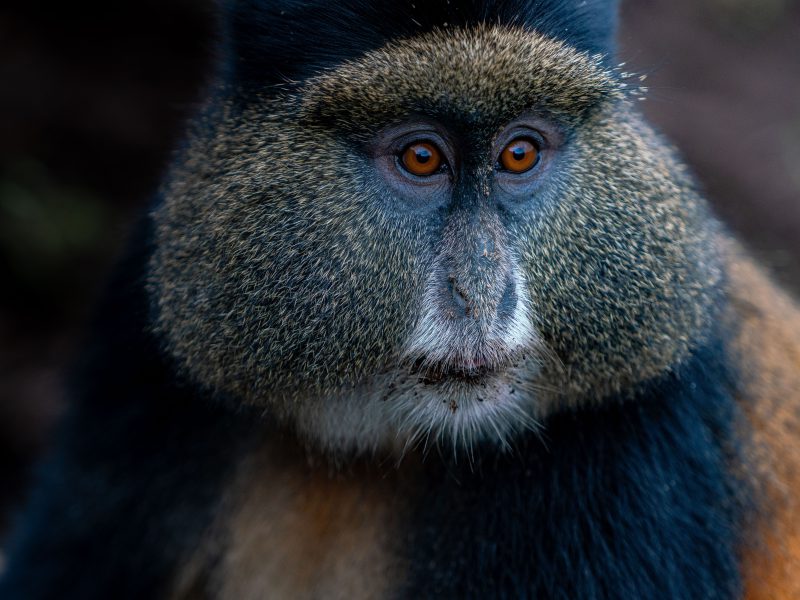
Nyungwe pairs beautifully with the rest of Rwanda. A typical sequence begins with Nyungwe in the south, moves to Volcanoes National Park for gorillas and golden monkeys, and finishes in Akagera for savannah wildlife. That is the shape of our seven-day safari, and it gives you a complete picture of the country in a week.
If you have less time, Nyungwe can be combined with a shorter gorilla trip, though the long drive means you need to plan carefully. For the gorilla side, see our guides to Rwanda gorilla trekking tours and the 3 day Rwanda gorilla trek, and for the savannah side,For Rwanda alongside Uganda, our 5 Day Uganda & Rwanda Safari are worth a look.
Nyungwe or Kibale?
Uganda’s Kibale Forest is famous for chimps and primates, and you can compare it with Nyungwe in our Kibale Forest National Park guide. Kibale is often described as the easier place to find chimpanzees, with a more relaxed forest walk. Nyungwe offers a wilder, higher and quieter setting, plus the canopy walk and a different kind of forest. If you are visiting both countries, you do not need to choose.
Nyungwe Forest canopy walk: frequently asked questions
How high is the canopy walk?
About 70 metres above the forest floor, which gives you views across and over the treetops.
Is it safe?
The walkway is a purpose-built structure with strong side netting and is operated by the park with trained guides. Follow the guides’ instructions and keep to the group limits, and it is a safe activity for most people.
Can I do it if I am afraid of heights?
Many nervous people manage it by moving slowly, focusing on the horizon and staying close to the centre. If you have severe vertigo, think carefully, and talk to us before you book.
How long does it take?
The walk and the approach trail usually take around one to two hours, depending on the pace of the group and how often you stop to look.
Can children do it?
Age limits and rules are set by the park and can change, so we check them for your dates. Older children and teenagers usually manage it well.
Do I need to book in advance?
Yes, especially in the dry months. Booking early secures your preferred date and lodge.
Is it worth the long drive?
For most visitors, yes. Nyungwe offers experiences you cannot get anywhere else in Rwanda, and an overnight stay turns the drive into part of the adventure.
Ready to walk above the forest?
The canopy walk is one of those experiences that sound simple and turn out to be remarkable. A narrow bridge, a vast forest, a clear morning and a quiet moment that you will remember long after the trip is over.
Tell us when you would like to go and what else you want to see, using our Plan Your Safari page or WhatsApp, and we will reply within 24 hours with a tailor-made proposal. For official information on the park, visit Visit Nyungwe, the Rwanda Development Board and Visit Rwanda.