

Why Golden Monkey Tracking in Mgahinga Belongs on Your Uganda Itinerary
Most people who travel to the far southwest corner of Uganda are chasing mountain gorillas, and that is fair enough. But tucked into the same misty volcano country is something that rarely makes the front page of a safari brochure: golden monkey tracking. In Uganda there is exactly one place where you can do golden monkey tracking. Mgahinga Gorilla National Park, a small, steep and bamboo-draped park pressed against the borders of Rwanda and the Democratic Republic of Congo, is the only protected area in the country that holds golden monkeys, and golden monkey tracking here is one of the most joyful, affordable and underrated primate experiences in East Africa.
Part of the appeal of golden monkey tracking is the contrast with gorilla trekking. Gorillas are calm, heavy and deliberate. Golden monkeys are the opposite: quick, curious, always on the move, leaping between bamboo stems with a flash of orange fur. A gorilla permit is one of the most expensive wildlife permits on the continent, while golden monkey tracking costs a fraction of that, which makes it an easy and rewarding addition for travelers watching their budget or simply wanting more primates in their week. If you are building a trip around Uganda’s southwest, this guide explains what golden monkey tracking involves, how the permits work, what the terrain and weather are really like, and how to combine the experience with gorillas, volcano hikes and Batwa culture.
Meet the Golden Monkey
The golden monkey, Cercopithecus mitis kandti, is a subspecies of the blue monkey, although you would struggle to believe that if you saw the two side by side. Where the blue monkey is a muted slate grey, the golden monkey wears a golden-orange cape across its back and upper flanks, set off by a dark face, pale cheeks and a long dark tail. Photographers fall for it immediately, which is why golden monkey tracking is so popular with camera-toting travelers. According to the species profile on Wikipedia, it lives in highland forest in the Virunga volcanic mountains, and it is typically found close to bamboo.
Bamboo is the clue to almost everything about this animal. Golden monkeys feed heavily on young bamboo leaves, shoots and branchlets, supplemented with fruit, flowers, shrubs and insects, particularly the pupae of moth larvae picked from leaves. They are opportunistic feeders, so when ripe fruit becomes available they shift toward it, and at the start of the rainy season they move to areas where bamboo shoots are sprouting. That seasonal movement is one reason the troops you meet during golden monkey tracking in Mgahinga can be in a different part of the forest from one week to the next.
Their social life is just as lively. Troops recorded in the Virunga region range from a handful of animals to more than sixty, with smaller groups tending to live at higher elevations. At night the monkeys often sleep in small subgroups of about four, tucked into the tops of dense bamboo, and they return to the same sleeping spots day after day. All of this makes the golden monkey one of the more watchable primates in East Africa, because the troop stays together, feeds in the open and rarely stays still for long.
It is also a species that needs help. The golden monkey is listed as Endangered on the IUCN Red List, with habitat loss, illegal removal of trees and bamboo, and conflict in parts of its limited range among the pressures it faces. That is a big part of why golden monkey tracking matters beyond the photographs: the permit income helps pay for the protection that keeps the forest standing.
Why Mgahinga Is the Only Place in Uganda
Golden monkeys live only in the Virunga volcano range and a small number of other forest fragments in the region, which is why there is just one site for golden monkey tracking in Uganda. Mgahinga Gorilla National Park is the Ugandan slice of that range, and the only home of golden monkey tracking in the country. Established in 1991, it covers about 34 square kilometres, making it one of Uganda’s smallest national parks, yet it packs an enormous amount into that space. The park encompasses three extinct volcanoes, Mount Muhabura, Mount Gahinga and Mount Sabyinyo, and climbs from roughly 2,200 metres at its lower edge to more than 4,100 metres on the volcano summits.
That altitude range creates distinct bands of vegetation: bamboo forest, montane forest, tree heath and, higher up, alpine moorland. The bamboo zone is where golden monkey tracking takes place, and it is also exactly the habitat the monkeys need. Mgahinga sits beside Rwanda’s Volcanoes National Park and the southern sector of Virunga National Park in the DR Congo, forming one continuous mountain ecosystem that the three countries share. You can read more about the wider range in this overview of the Virunga Mountains.
The park lies about 15 kilometres by road south of the town of Kisoro and roughly 55 kilometres west of Kabale. Beyond the monkeys, it protects a checklist of more than seventy mammal species, one habituated gorilla family and a long list of Albertine Rift endemic birds, among them the Rwenzori turaco and several sunbirds.
How Golden Monkey Tracking Works, Step by Step
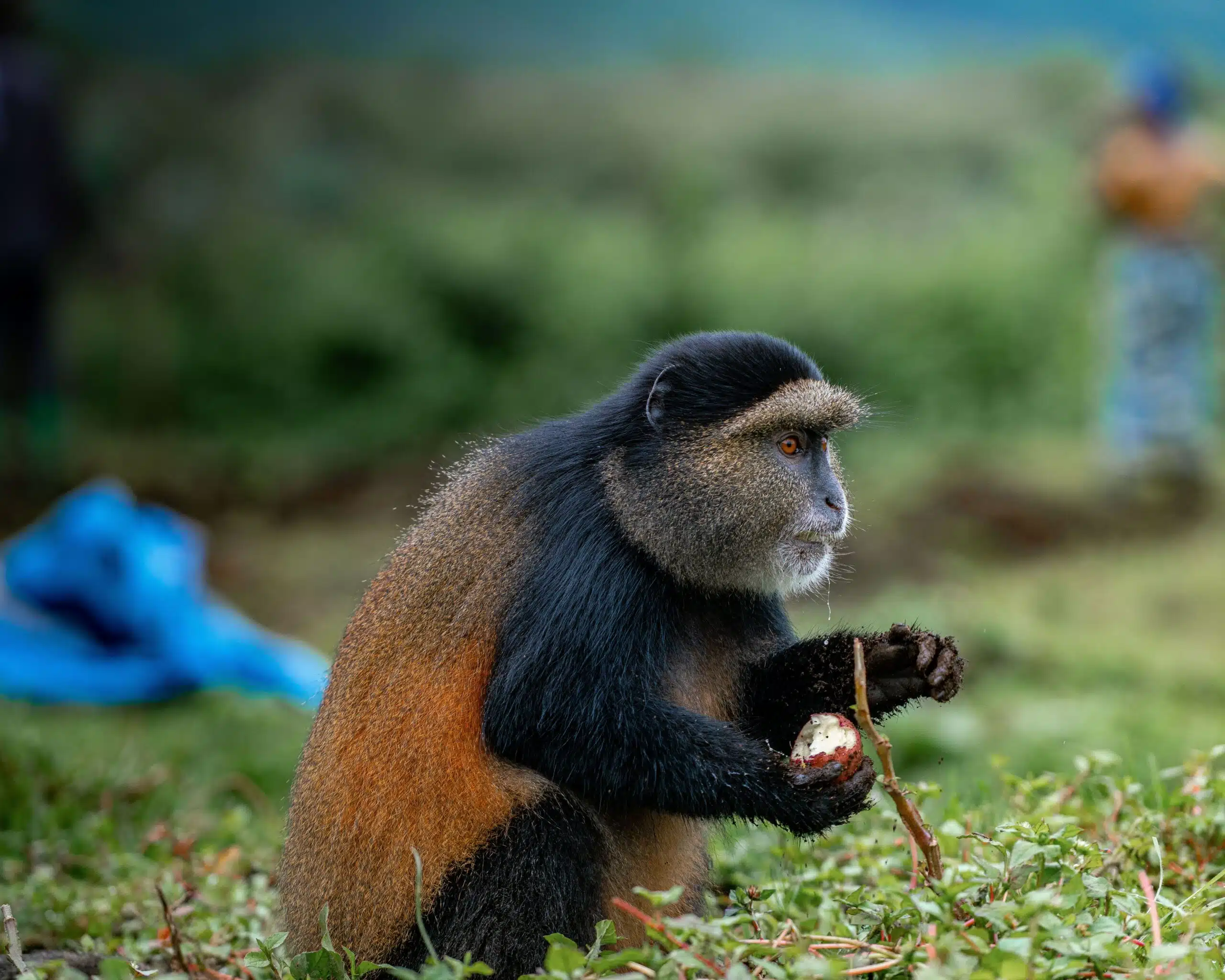
A typical day of golden monkey tracking begins early. Visitors gather at the park headquarters for a briefing with the rangers, usually around 7:30 in the morning, with the walk starting shortly afterward. For golden monkey tracking, rangers explain the rules, introduce the guides and trackers, and divide the visitors into small groups. A golden monkey tracking permit is for the animals, not for a fixed route, so the exact walk depends on where the troop spent the night and where it is feeding that morning.
On a golden monkey tracking morning, trackers generally head out ahead of the group to locate the monkeys, and the rest of the party follows with a guide and an armed ranger. The walk to the troop during golden monkey tracking can be short or can take a good part of the morning, depending on where the monkeys have moved. The whole golden monkey tracking outing, including the walk in and out, normally takes between two and four hours. Once the troop is found, the standard golden monkey tracking permit allows one hour with the monkeys, which sounds short until you are standing among bamboo with a dozen animals bounding around you.
During that hour of golden monkey tracking the monkeys do what they always do: feed, groom, squabble, play and move on. Because they are so active, golden monkey tracking feels very different from sitting quietly with a resting gorilla family. You stay mobile, following the troop through the bamboo, and the rangers keep a respectful distance from the animals while still giving you views close enough for good photographs.
Some basic rules apply to golden monkey tracking, much as they do on any primate encounter in Uganda. Keep your voice low, follow your guide’s instructions about distance, avoid flash photography, and do not eat or drink in front of the animals. Anyone who is sick with a cold or other contagious illness should say so before golden monkey tracking, because primates can catch human infections. The rangers brief all of this at the start, and the Uganda Wildlife Authority publishes official visitor information at ugandawildlife.org.
The Golden Monkey Habituation Experience
If one hour is not enough, Mgahinga also offers a longer option beyond standard golden monkey tracking: the golden monkey habituation experience. Instead of a single hour with a troop that is already comfortable around people, habituation lets you spend extended time, up to about four hours in many descriptions, with a group that researchers and rangers are still accustoming to human presence. You walk alongside trackers and researchers, watching how the monkeys behave while they are not yet fully relaxed around observers, and you learn how habituation actually works.
This is a genuinely different encounter from standard golden monkey tracking. The troop may be more cautious and more mobile, and the experience rewards patience and good fitness, but you come away with a far deeper sense of the monkeys’ daily routine. It costs more than a regular golden monkey tracking permit and spaces are limited, so ask your operator whether it is available for your dates before you arrive. Like standard tracking, it is offered only in Mgahinga within Uganda.
Permits, Costs and Booking
Golden monkey tracking permits are issued by the Uganda Wildlife Authority, either directly or through a licensed tour operator. They are the cheapest of Uganda’s primate permits, far below the price of a gorilla permit and well below chimpanzee tracking, which is exactly why so many travelers add golden monkey tracking to a gorilla trip rather than treating it as a substitute for one. A habituation permit costs more than a standard golden monkey tracking permit, though still much less than a gorilla permit.
Be careful with exact prices. Permit fees are set by the Uganda Wildlife Authority under a published tariff, the tariff is revised from time to time, and different websites quote different figures depending on which tariff period they were written in. For that reason this guide deliberately avoids quoting a number. Check the current rate with the authority or with your operator when you book your golden monkey tracking, and confirm what is included, since park entry arrangements and categories for foreign non-residents, foreign residents and East African citizens can differ.
Unlike gorilla permits, which sell out months ahead, golden monkey tracking permits are usually easier to secure at shorter notice, but we would still book ahead if you are traveling in peak season or in a larger group. The authority also sets a minimum age for tracking, and published figures have varied over the years, so confirm the current rule if you are traveling with teenagers. Permits are tied to a specific date, so your operator will normally reserve your golden monkey tracking slot alongside your gorilla permit and lodge.
What the Trek Is Really Like: Fitness, Terrain and Weather
Golden monkey tracking is generally easier than gorilla trekking, but easier does not mean effortless. You are walking on volcanic slopes at roughly 2,300 to 3,000 metres, where the air is thinner than most visitors are used to, and the paths can be steep, muddy and slippery. Walks to find the troop on a golden monkey tracking morning commonly last somewhere between one and two hours, though they can be much shorter on a lucky morning. A reasonable level of fitness and sturdy hiking boots are enough for most people on a golden monkey tracking trip, and rangers go at the pace of the slowest member of the group.
Weather matters more than people expect. Mgahinga has two rainy seasons, roughly February to May and September to December, with the heaviest rainfall in the wetter part of the year and the driest conditions around June to August. For golden monkey tracking in the rains, the bamboo drips, the ground turns to mud and clouds can hide the volcano summits, though the forest looks spectacularly green. In the dry months the paths for golden monkey tracking are firmer and the views clearer, and the best weather for golden monkey tracking usually falls in June to August and December to February. Either way, pack a waterproof jacket, gaiters if you have them, and warm layers, because the mornings are cold at this altitude.
Because the monkeys move with the seasons, there is no month when golden monkey tracking is impossible, but the walk can be longer or shorter depending on where the troop is feeding. A good guide treats a golden monkey tracking day as flexible and will not promise a particular route.
Photographing Golden Monkeys
Golden monkey tracking gives you a challenging and rewarding photographic subject. They are fast and constantly moving, and they live in the shade of bamboo, where light is dim and dappled, so cameras struggle with both speed and exposure. If you can, bring a camera with a fast autofocus and a lens in the 100 to 400 millimetre range. Raise your ISO rather than using flash, which is not allowed and stresses the animals, and use a shutter speed fast enough to freeze movement.
Look for the golden-orange back catching a shaft of sunlight, because that is the shot everyone wants from golden monkey tracking. Patience beats persistence: stay still, let the monkeys come to you and watch for moments when the troop settles to feed or groom, which is when you get sharp, calm frames. A waterproof cover for your camera is worth carrying in the wetter months, and spare batteries help in the cold. On a golden monkey tracking morning the rangers will usually give you a minute or two to settle, so use that time to set your exposure before the troop moves again.
Combine Golden Monkeys with Gorillas, Volcano Hikes and Batwa Culture
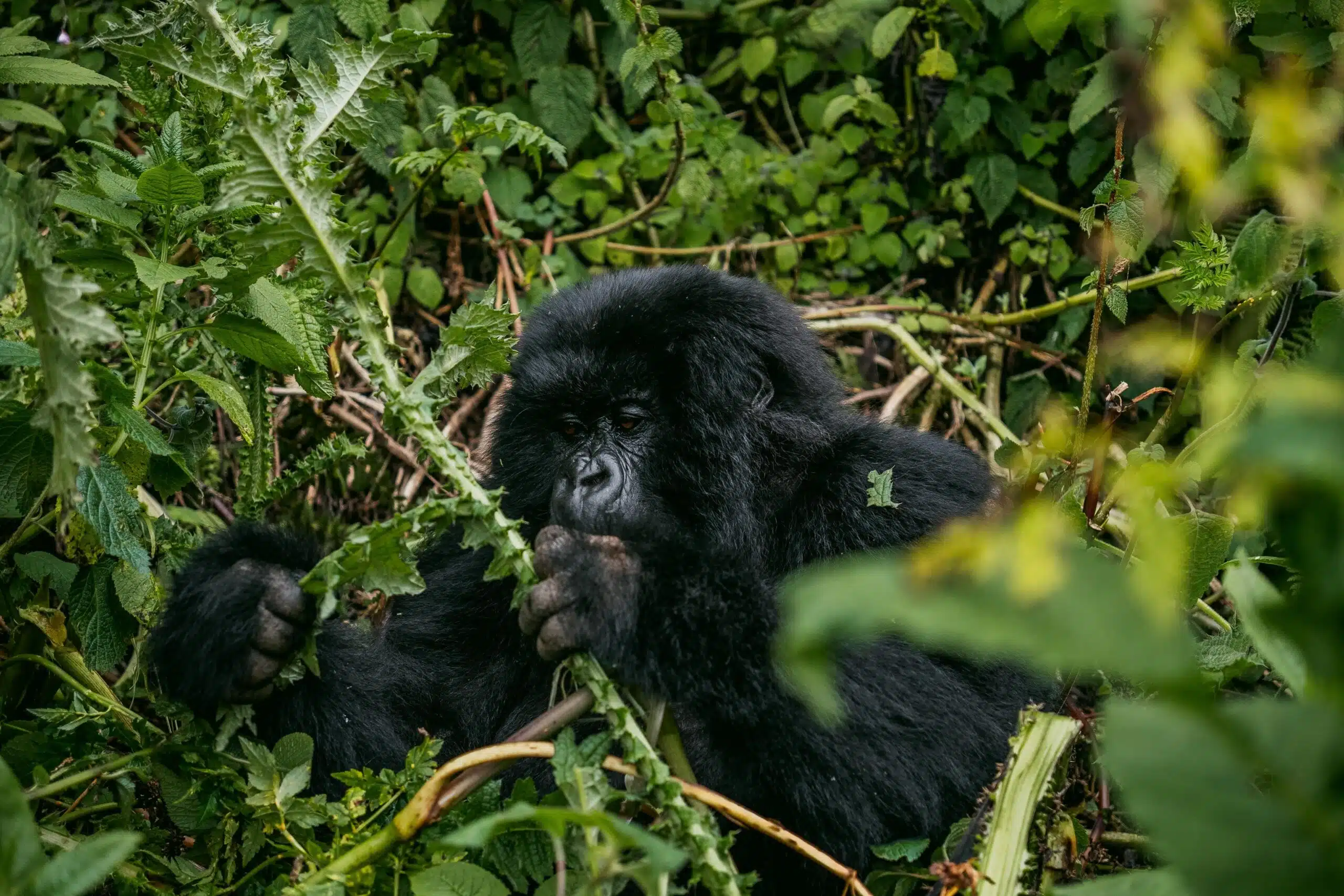
The best reason to spend two or three nights near Mgahinga is that golden monkey tracking is only one of several experiences available in a small area. The park’s single habituated gorilla family, the Nyakagezi group, offers gorilla trekking with fewer visitors than Bwindi, and many travelers plan golden monkey tracking on the day before or after their gorilla trek. guide to combining golden monkeys and mountain gorillas walks through sample itineraries, and the Bwindi and Mgahinga gorilla safaris guide compares places to stay in both parks.
Volcano hikes are the other big draw. Climbers can tackle Mount Sabyinyo, Mount Gahinga or Mount Muhabura, each offering different levels of difficulty and a view across Uganda, Rwanda and the DR Congo. The Sabyinyo hike passes through several vegetation zones, and you may even meet golden monkeys along the way. If you want something gentler, the Batwa cultural experience introduces the indigenous people who once lived in these forests and shows forest survival skills passed down over generations, which adds a human story to the wildlife. The Batwa are one of the oldest forest peoples in the region, and background on the Great Lakes Twa explains more about their history and the challenges they have faced since the forests became protected.
A simple three-day plan or more that includes golden monkey tracking works well: arrive and settle in on the first day, do golden monkey tracking on the second morning and a cultural walk in the afternoon, then trek gorillas on the third day. Adding a volcano hike stretches it comfortably to four.
Golden Monkeys in Uganda or Rwanda?
Golden monkeys also live in Rwanda’s Volcanoes National Park, where tracking is arranged through the Rwanda Development Board, so travelers sometimes ask which side of the border is better for golden monkey tracking. Both versions of golden monkey tracking give you the same animals in the same bamboo habitat. The honest difference is that golden monkey tracking in Mgahinga is generally cheaper, usually quieter, and combines naturally with a Ugandan gorilla itinerary, while Rwanda’s version of golden monkey tracking fits best if you are already based near Kigali and Volcanoes National Park.
If you are following the volcano chain across the border, you can do golden monkey tracking in both countries and compare, and Uganda versus Rwanda gorilla guide explains the wider differences in cost, logistics and experience.
Getting There and Where to Stay
Reaching the only golden monkey tracking site in Uganda takes some planning. Mgahinga is in Kisoro District, in the extreme southwest corner of the country. By road it is roughly eight to nine hours from Kampala, a long but scenic drive through the highlands, while a flight to Kisoro airstrip shortens the journey considerably for travelers short on time. Many visitors approach from Kabale or from Bwindi, which makes Mgahinga a natural last stop on a gorilla circuit. Travelers can also reach it from Kigali in Rwanda, since the border is close.
Accommodation for golden monkey tracking ranges from comfortable lodges beside the park entrance to simpler guesthouses in Kisoro. One lodge sits only a short walk from the main park gate, which saves an early-morning drive on tracking days and gives easy access to the ranger briefing. Whichever place you choose, book ahead in the dry season, because the best rooms near the park entrance are limited and fill up quickly during gorilla permit peaks.
Why Golden Monkey Tracking Matters for Conservation
It would be easy to treat golden monkey tracking as a pleasant extra, but it plays a real role in protecting the animals. The species is listed as Endangered, its range is small and fragmented, and its habitat is under pressure from the removal of trees and bamboo. Tourism built around golden monkey tracking gives the forest an economic value beyond timber and farmland. Golden monkey tracking permit fees support park management and ranger patrols, and local communities benefit through employment as guides, porters, cultural performers and lodge staff, giving people living around the park a stake in keeping the bamboo intact.
You can support golden monkey tracking by following the rules, hiring local guides and porters, buying from community crafts groups and staying at locally run lodges. These small choices help ensure that golden monkey tracking remains a sustainable activity rather than a pressure on the animals it relies on.
Frequently Asked Questions About Golden Monkey Tracking
Where can I do golden monkey tracking in Uganda? Only in Mgahinga Gorilla National Park in Kisoro District. No other park in Uganda has golden monkeys, so there is no alternative site within the country.
How long does golden monkey tracking take? The whole outing usually takes two to four hours including the walk, with one hour spent with the monkeys. The walk to find the troop varies from day to day.
Is golden monkey tracking difficult? It is easier than gorilla trekking, but you are still walking uphill at altitude on muddy bamboo-forest paths. Most reasonably fit visitors manage it comfortably.
How much does a golden monkey permit cost? It is far cheaper than a gorilla permit, but the exact fee depends on the Uganda Wildlife Authority tariff in force when you travel, so confirm the current figure with your operator or the authority.
Can I do golden monkey tracking and gorilla trekking on the same trip? Yes, and most visitors do. They are normally scheduled on different days, because both involve early starts and a morning of walking.
What should I wear for golden monkey tracking? Waterproof jacket, long trousers, sturdy hiking boots, gloves for gripping bamboo, warm layers and a rain cover for your camera.
Plan Your Golden Monkey Tracking Safari with Afoyo Africa Safaris
Golden monkey tracking is one of those experiences that surprises almost everyone who tries it. You expect a pleasant walk and a few monkeys, and you leave remembering the sheer energy of a troop moving through a golden-lit bamboo forest. Because the activity is possible in only one park in Uganda, it deserves a deliberate place in any southwestern itinerary rather than being left as an afterthought.
Afoyo African Safaris builds golden monkey tracking into a Mgahinga itinerary that fits your dates and budget, whether you want a quick add-on to a gorilla trek, a longer stay with volcano hikes and Batwa culture, or a full southwest circuit including Bwindi and Lake Bunyonyi. Get in touch to start planning golden monkey tracking in Mgahinga and see why this small park has such a big reputation.